Rowin Mol · November 10, 2026 · (2 weeks ago) · updated Nov 19
In short
Mats and Mila had been together for six years and lived in Utrecht. Mats wanted to ask her to marry him, and she had no idea yet. In this series you follow them on their way to their wedding.
In the previous episode, Mats found out Mila's ring size with help from her sister Fenne. A budget he already had. Now he just had to find the ring itself.
On Thursday morning Mila was in the shower. Her thin silver-coloured ring lay on the edge of the washbasin. Mats took a photo of it, and then another one up close.
"What are you doing with your phone in the bathroom?" she called out over the water.
"Email from the contractor."
On Saturday Mila had a course. Mats picked up his mother, showed her the photo and drove to the jeweller where they had been handed a tray full of rings last time. He knew what he was looking for: white gold, narrow, no high stone. He said so too. The sales assistant nodded, went to the back and returned with a book as thick as an old phone directory.
"This is what we can order," he said. "And there is more on the wholesaler's website." He put a tablet next to the book.
Half an hour later Mats had fourteen model numbers in his notes. By number nine he could no longer remember what number three looked like.
"Could you send me that link? Then I can take my time looking at home."
"I'm afraid not. That site is behind our login. They are not online anywhere else."
Mats looked at the book. At work he never got fourteen options, and if he did, he crossed out eleven. His mother slid the book a little towards herself and closed it.
"Show him that photo," she said.
Below you can read how to choose from all those rings without losing track of number three by number nine. After that comes the difference between a natural and a lab-grown diamond.
At the jeweller you are often shown far more than what is in the display case. That is great, until you have hundreds of almost identical rings in front of you. This helps:
The sales assistant looked at the photo for a long time. Then he opened the book at a page somewhere near the back and turned it towards Mats.
A narrow white gold band, almost as thin as Mila's ring, with a row of small diamonds set low into the top of the band. The underside was smooth.
It looked like what Mila wore every day, but as an engagement ring, with diamonds. Mats felt his ears go warm. He knew this was the ring.
"That one," he said, tapping the page.
"So how many have you seen?" his mother asked.
"Fifteen. That's fourteen too many."
The sales assistant wrote down the model number. "Then the next question is: natural diamonds, or lab-grown? We make this design with both."
A lab-grown diamond is a real diamond that grows in a lab in a few days or weeks, instead of in the earth. According to GIA, a laboratory that grades diamonds, it is not an imitation, although it is not the same as a natural diamond either. The chemical composition and the crystal structure are virtually identical, and the same goes for the physical properties.
Do not confuse it with cubic zirconia. That looks like a diamond, but is a different, much cheaper material.
The question was not entirely new to Mats. At the first jeweller, two rings had been lying side by side that looked almost the same, one with a natural diamond, the other with one from a lab.
"Can you tell which one it is on her finger?" he asked.
"Not without a test," said the sales assistant.
"So where's the difference?" his mother asked.
Some shops mainly sell one of the two, and explain the difference from that point of view. This is what you can check:
Which is better depends on what matters to you. Lab-grown gives you a bigger stone for the same money, or you have money left over. A natural stone comes from the earth and has held its value better so far.
His mother, meanwhile, had a question of her own. "And in ten years? What will it be worth then?"
The sales assistant explained. Mats listened and looked at the page.
"If Mila ever sells that ring," he said, "I've got a different problem."
His mother laughed so hard that the sales assistant had to laugh too. Then she asked whether the ring could be made smaller if it did not fit. It could, because the underside was smooth.
The sales assistant laid two sheets on the counter and started talking about colour G and clarity VS. Mats typed along and stopped halfway.
"I was just pleased I knew what a carat was," he said.
At a jeweller you will soon hear about the 4 Cs, the four words used to grade diamonds. The scales below come from GIA. In June 2025 that laboratory announced it no longer uses the colour and clarity terms for lab-grown stones. It now calls such a stone "premium" or "standard", because more than 95 per cent of lab-grown diamonds are very close to each other in colour and clarity. Reports from other laboratories may still show the scales, so ask what the report for your stone says.
Ask for a certificate. With a larger stone you can expect a report from a laboratory such as GIA, HRD or IGI. It should also state whether the stone is natural or lab-grown. With a row of small stones you usually do not get a certificate per stone, because that often costs more than the stone is worth. In that case, ask the jeweller to put on the receipt which stones they are.
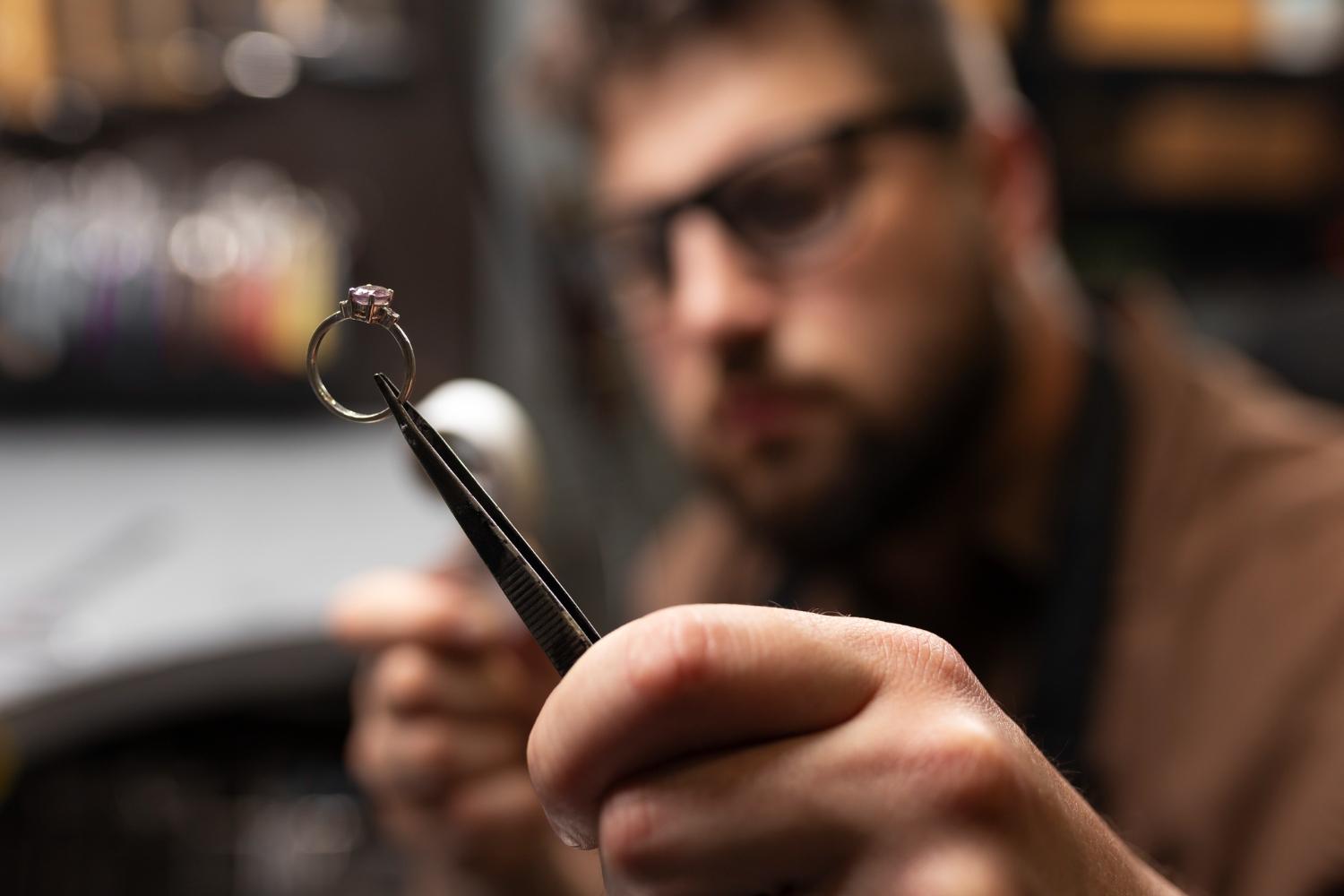
Mats asked the price of both and put them in his notes. Then he took his mother home. On Monday he rang the jeweller from the car, on his way to the building site, and ordered the ring.
On the way back he rang his mother to say it was sorted.
"Well? Which stone did you go for?"
"What did your ring cost?"
There was a brief silence. "I don't know," she said. "I never asked."
"Well then," said Mats.
She laughed. "You're just like your father."
Mila was sitting at the kitchen table when he got home, phone in hand and frowning.
"Fen has sent 'WELL????' to the family group. And a minute later: 'sorry wrong chat.'"
"She probably wants to borrow something again," said Mats, opening the fridge.
Mila laughed. "There's still pasta on the hob."
Later that evening he messaged Fenne: "Ordered. And learn to tell those chats apart."
He had a ring now. On paper, at least. The jeweller only made it after the order, and Mats had not asked about the delivery time. How tight that got, you can read in the next episode, about having an engagement ring made.
Mats and Mila are made up, and so are their photos: those were created with AI. Their questions, doubts and blunders are not: they come from real couples, including ourselves.
You can find all episodes in one place in Mats and Mila's wedding story.

Rowin Mol
Rowin Mol is the founder of BruiloftBuddy. He got married in 2024 and, while planning his own wedding, found that on top of the tools he was using he still needed a separate spreadsheet for the guest list, attendance and the wedding day timeline.
Out of that frustration he built BruiloftBuddy: the platform he wished he'd had himself.
Try it yourself
Build your own wedding website
The editor on the homepage is the real editor, not a video. You see what you're making straight away.
Open the editorRowin Mol
Rowin Mol is the founder of BruiloftBuddy. He got married in 2024 and, while planning his own wedding, found that on top of the tools he was using he still needed a separate spreadsheet for the guest list, attendance and the wedding day timeline.
Out of that frustration he built BruiloftBuddy: the platform he wished he'd had himself.
Try it yourself
Build your own wedding website
The editor on the homepage is the real editor, not a video. You see what you're making straight away.
Open the editorYes. A lab-grown diamond is not a fake: its chemical composition and crystal structure are virtually the same as those of a natural diamond. It has simply been grown in a lab instead of in the earth. Cubic zirconia, on the other hand, is an imitation.
When you buy it, it costs much less than a natural diamond. Selling it later usually brings in little, because there is hardly any second-hand market.
Not with the naked eye: it looks like a natural stone of similar quality. You need testing equipment, and you only know for sure through a laboratory. For a larger stone, it should be stated on the certificate.


