Rowin Mol · October 29, 2026 · (4 weeks ago) · updated Nov 19
In short
Sooner or later, while choosing wedding rings, the question comes up of which hand they will go on. In the Netherlands you see both, and there is a reason for that.
Short answer: in the Netherlands, either is fine. Traditionally, Catholics wear the wedding ring on the left and Protestants on the right. In Germany, Austria, Poland and Russia it goes on the right; in the United Kingdom, the US, Sweden and Finland on the left. It always goes on the ring finger, the fourth finger. If you follow no tradition, choose your non-dominant hand: the ring gets in the way less there and takes fewer knocks. Some Dutch couples already wear the wedding ring on the other hand during their engagement and switch hands after the wedding.
Below you can read where left and right come from, how it works in other countries, what to do with your engagement ring and what to arrange before the wedding day. If you only want to know how to choose for yourself, go to Which hand do you choose if you follow no tradition?.
Both. Two traditions exist side by side in the Netherlands: Catholics wear their wedding ring on the left hand, Protestants on the right. There is no law or national rule. So you do not have to explain your choice to anyone.
If you are not religious, or feel little connection to either tradition, you are free to choose. You can follow the hand your parents used, or simply see what feels comfortable.
A lesser-known Dutch custom is switching hands. Engaged couples sometimes wear the ring that will later become the wedding ring before the wedding, on the other hand. After the wedding it moves to the wedding hand. That way you can tell from someone's hand whether they are engaged or married.
Still waiting for the proposal? In the story of Mats and Mila you can read which steps come before the proposal, from ring size to asking for her hand.
The left hand comes with an old story. A vein was said to run straight from the left ring finger to the heart: the vena amoris, the vein of love. Anatomically that is not true, yet the image has stuck. In the Church of England, the left hand was fixed in the Book of Common Prayer of 1662, the prayer book that also contains the marriage service. In the United Kingdom, the United States and Canada the left hand is still the custom.
For the right hand there is a different explanation: the right hand has traditionally been the hand you make a promise with, in an oath or a handshake. Whether the custom really started that way can no longer be verified. The right is the hand of Dutch Protestants, and in Germany, Austria, Poland and Russia it is the usual wedding hand.
If you are marrying someone from another country, the difference may stand out. An overview:
In the United States and Canada, for a long time only women wore a wedding ring. It was not until the twentieth century that it became normal for both partners to wear one.
If one of you comes from a country not listed here, ask your family how it is done there.
If you have an engagement ring, you have three options:
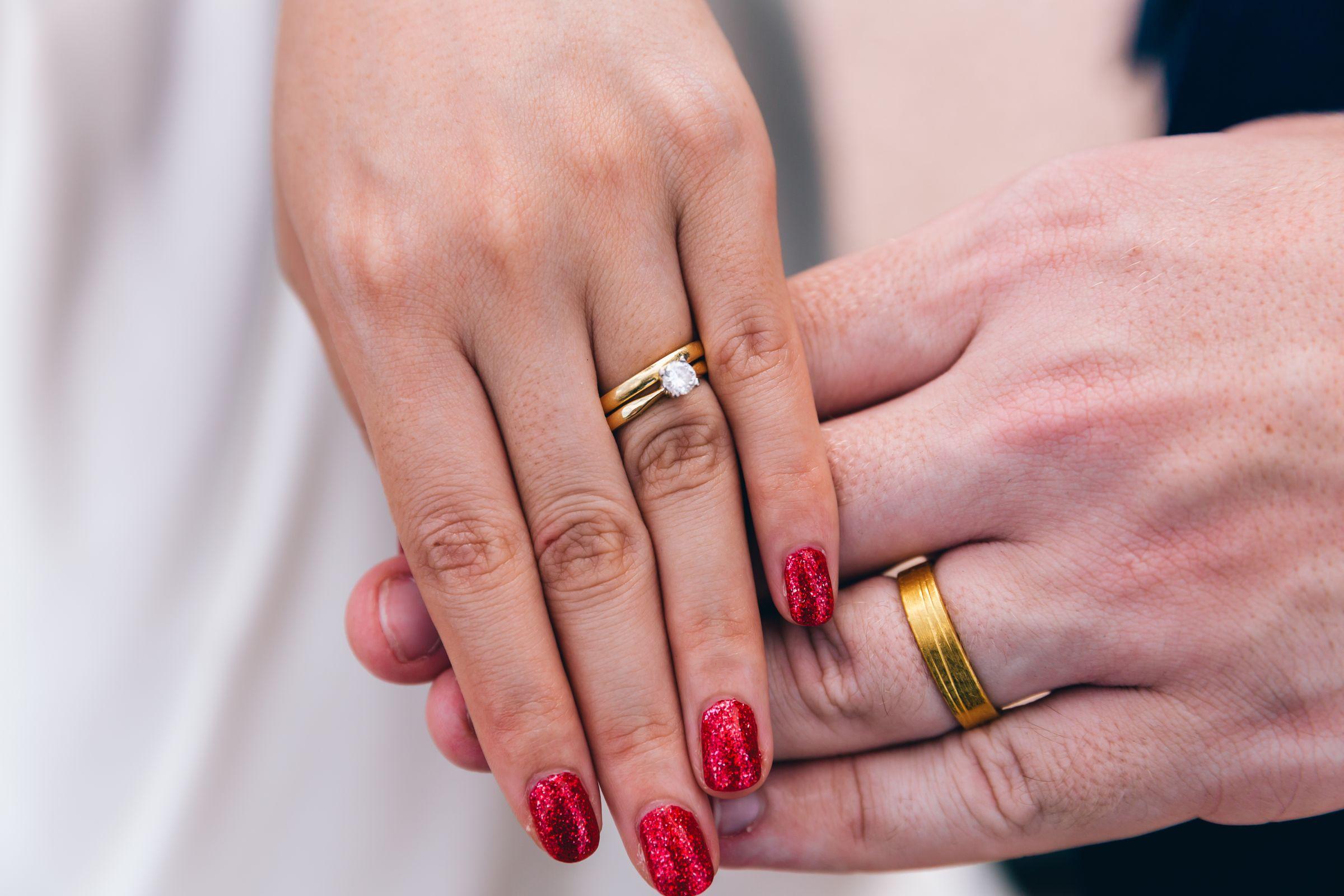
Whichever way you choose, agree on it before the wedding day. Then your partner knows straight away which hand the ring goes on during the ring exchange.
Then you can choose on purely practical grounds. If you are right-handed, a ring on your left hand gets in the way less when you write or do odd jobs, and it takes fewer knocks.
We are not religious, so we also chose for comfort. The left is the non-dominant hand for both of us, so that is where we wear our wedding rings, on the ring finger. I had never worn a ring before, and at the office I use a mouse a lot. I do not like a ring knocking against that mouse, another reason for the left.
A few things to weigh up:
You do not have to choose the same hand. If one of you wears it on the left and the other on the right because that suits your work better, that is just as good.
Once you know the hand, there is still some practical work left: first at the jeweller, then on the day itself.
When you order, ask about the delivery time, especially if you are having the rings engraved or the size still needs adjusting. Count back from your wedding date so there is time left if something does not fit. The BruiloftBuddy checklist includes "Choose and order wedding rings" as a standard checklist item, with visiting jewellers as a task. That way it is on your list before the delivery time gets tight.
For the wedding day itself:

Rowin Mol
Rowin Mol is the founder of BruiloftBuddy. He got married in 2024 and, while planning his own wedding, found that on top of the tools he was using he still needed a separate spreadsheet for the guest list, attendance and the wedding day timeline.
Out of that frustration he built BruiloftBuddy: the platform he wished he'd had himself.
Try it yourself
Build your own wedding website
The editor on the homepage is the real editor, not a video. You see what you're making straight away.
Open the editorRowin Mol
Rowin Mol is the founder of BruiloftBuddy. He got married in 2024 and, while planning his own wedding, found that on top of the tools he was using he still needed a separate spreadsheet for the guest list, attendance and the wedding day timeline.
Out of that frustration he built BruiloftBuddy: the platform he wished he'd had himself.
Try it yourself
Build your own wedding website
The editor on the homepage is the real editor, not a video. You see what you're making straight away.
Open the editorThe fourth finger, between your middle finger and your little finger. It is the same finger on your left and your right hand.
In the Netherlands they mean the same thing: that someone is married. The left hand comes from the Catholic tradition, the right from the Protestant one. If you do not follow a tradition, you choose the hand that feels comfortable. If you see a ring on the other hand than you expect, it may also be an engagement ring. In Germany, Austria, Poland and Russia the right hand is standard.
The same traditions apply to men as to women: in the Netherlands the left hand if you are Catholic, the right if you are Protestant, or the hand that suits you best. As a couple you do not have to choose the same hand.
No, there is no rule for that. Two identical rings is fine, but you can also just keep the material the same and each choose your own width or finish.
Yes. The hand you wore it on at your wedding is not set in stone. If the ring gets in the way at work or during a hobby, just wear it on your other hand. Do have the size checked, though, because it can differ from hand to hand.


