Rowin Mol · October 10, 2026 · (2 months ago) · 12 min reading time · updated Nov 19
In short
You have picked the card, the design is done, and now it needs words.
Short answer: the wording on a wedding invitation is made up of six fixed blocks. An opening line, your names and the date, the ceremony, how the day continues, which part of the day someone is invited to, and a request to reply with a deadline. Everything else is optional.
The biggest collections of example wording are on stationery and print shop websites, sometimes more than a hundred lines, and there is good material among them. But they are loose lines one after another, with no explanation of which parts belong on a card or in what order, so you still end up piecing a card together yourself.
Below you will first see how the wording is put together, with variants per block that you can combine yourself. After that come ten complete invitations in five styles, the wording for day guests and evening guests, the tricky messages such as a gift note, and what tends to go wrong on cards. If you have day guests and evening guests and that is your main doubt, go straight to How do you make clear who is invited to which part of the day?
Six blocks, in this order. Pick a variant per block that suits you and put them one under the other. Then you have complete wording before you have had to come up with a single sentence yourself.
Block 1: the opening line. This sets the tone for the rest of the card.
Block 2: names and date. The names are almost always larger than the rest, so they do not need a sentence around them. For the date you do have a choice to make:
The last one suits a formal card. The second and third leave out the day of the week, so your guests have to work out which day it is. So add the weekday, and write the month in full if there is room.
Block 3: the ceremony. This needs to say where, what time, and from what time guests are welcome.
Mind the difference between the start time and the time you want your guests seated. Give both, or half of them will still be outside when you walk in.
Block 4: how the day continues. Keep this short. The full programme belongs in your wedding day timeline.
Block 5: which part of the day someone is invited to. This block gets its own section below.
Block 6: the request to reply. Further down there is a separate section about the wording and the deadline.
Nothing more than these six needs to go on the card. A gift note, the dress code and a pointer to your website only go on if there is room left. On an A6 card, 105 by 148 millimetres, that fills up faster than you think.

Below are ten complete invitations, two per style. Feel free to copy and adapt them; that is what they are for. Pay most attention to the tone; you will replace the exact words anyway.
Suits a ceremony at a town hall or church, and a guest list with lots of aunts, uncles and colleagues.
With joy and gratitude, we are pleased to announce our marriage.
[Name] and [Name]
The marriage ceremony will take place on Saturday [date] at [time] at [town] Town Hall.
Afterwards we would be delighted to welcome you at our reception at [venue], [address], from [time] to [time].
We would be grateful if you could let us know by [date] whether you will be able to attend.
It is with great joy that we invite you to the celebration of our marriage.
[Name] and [Name]
[Date] at [time], [venue], [town].
Afterwards you are warmly invited to join us for dinner and the evening party at [venue].
Kindly reply by [date] to [contact details of our master of ceremonies].
This tone sounds like the way you talk, and stays polite enough for the aunt you see once a year.
We're getting married!
After [number] years together, [number] house moves and one dog who couldn't care less, we are saying I do.
[Name] & [Name]
[Date]
At [time] we say yes at [venue]. You are welcome from [time].
After that we'll eat, drink and dance the night away at [venue].
Will you let us know by [date] if you can make it?
The day is almost here.
On [date] we promise to stay together for good. We would love you to be there.
[Name] & [Name]
Ceremony at [time] at [venue]. You are welcome from [time].
Followed by drinks, dinner and a party at the same place.
Please reply by [date] via [link or contact details].
For a card with lots of white space, a small format, or a design where the text does not play the lead role.
[Name] & [Name]
are getting married
[Date] · [time] · [venue]
Party into the small hours.
Let us know by [date] if you're coming.
We're getting married.
[Name] and [Name]
[Date], [time], [venue]
Coming? Let us know by [date].
Only works if this is how you talk anyway. Not sure? Read it aloud to someone who did not help write it.
Good news for everyone who has been asking for years: we're getting married.
[Name] & [Name]
On [date] at [time] we make it official at [venue]. Please be on time: [name] took long enough to get here and does not want to do this moment twice.
After that: food, drinks, and a dance floor we have zero expectations of.
Let us know by [date] if you'll be there.
After a [number]-year trial period, we are making the contract official.
[Name] & [Name] · [date]
Signing at [time] at [venue]. The witnesses are sorted, the audience is not. That's where you come in.
Followed by a party at [venue] until [time].
Please reply by [date].
A poem or a short line at the top, with the practical information set out plainly underneath. That combination works better than a whole card full of rhyme.
Two lives, one direction.
On [date] we commit to each other, and we would love to celebrate that with you.
[Name] & [Name]
Ceremony at [time] at [venue]. Welcome from [time].
Dinner and party to follow at [venue].
We would love to hear from you by [date].
What began with a chance evening will never end.
[Name] & [Name] will say their vows on [date] at [time] at [venue].
Then we celebrate until the sun comes up.
Can you be there? Let us know by [date].
At many weddings, some guests are welcome all day and others only arrive in the evening. The wording has to show straight away which group someone is in, before they have to guess. Who you make an evening guest and what time you ask them to come is covered in inviting and planning for evening guests.
For day guests:
For evening guests:
For a congratulations reception:
The safest rule of thumb: put only the parts of the day a guest is invited to on their card. If the ceremony time is on an evening guest's card, sooner or later someone will turn up at two in the afternoon. Printing two versions costs a little more and saves a lot of explaining afterwards. We had day guests and evening guests ourselves, so we had two kinds of cards printed. Each card showed the programme for that type of guest, with its own QR code. If you would rather have one card for everyone, add a separate insert card with the order of the day for your day guests.

This block is one or two sentences long and decides how much work you have in the months that follow. It involves two choices.
The first choice: do you ask everyone to reply, or only those who can't come? The difference sounds small.
If you only ask people to tell you if they can't come, silence is your only information. Anyone who stays quiet goes down as "coming", until you have an empty seat on the day itself. If you ask everyone to reply, you know where you stand with every guest, even if you have to remind a few people. For the numbers you give your caterer, that is the difference between counting and guessing.
Wording that asks everyone to reply:
Wording that only asks people to say if they can't come:
The second choice: where do the replies come in? Add an address, phone number or link. Without it you get replies via WhatsApp, by email and in person, and then you are left piecing them together afterwards. If you use a master of ceremonies (ceremoniemeester, the friend who runs the day in Dutch weddings), add their name and one way to reach them. If you point to an online form or your wedding website, the replies arrive in one place and you can check them against your guest list without retyping anything.
And add a deadline. Always. An invitation without a date stays on the mantelpiece until you chase it up. Choose a day well before your own deadlines, for example before the moment your caterer wants final numbers. If you use the abbreviation RSVP, first read what RSVP means and how to put it on your invitation: not all your guests will know it.
These are the sentences people agonise over longest, because it feels like asking for something. Short and without apology works best.
Gift note:
Would you rather ask for money? Then read how to ask for money as a couple.
No children:
Dress code:
Do not put all three on the card. Choose one at most and point to your wedding website or a separate information card for the rest. The more lines on the card, the less it reads like an invitation. What belongs on a site like that is covered in what to put on a wedding website and how to start.
Four things keep coming up, and you can fix all four before the card goes to the printer.
There is only one time on the card. Guests then do not know whether they need to be there by that time or whether that is when it starts. "Arrive from 2.30pm, ceremony at 3pm" leaves no room for doubt.
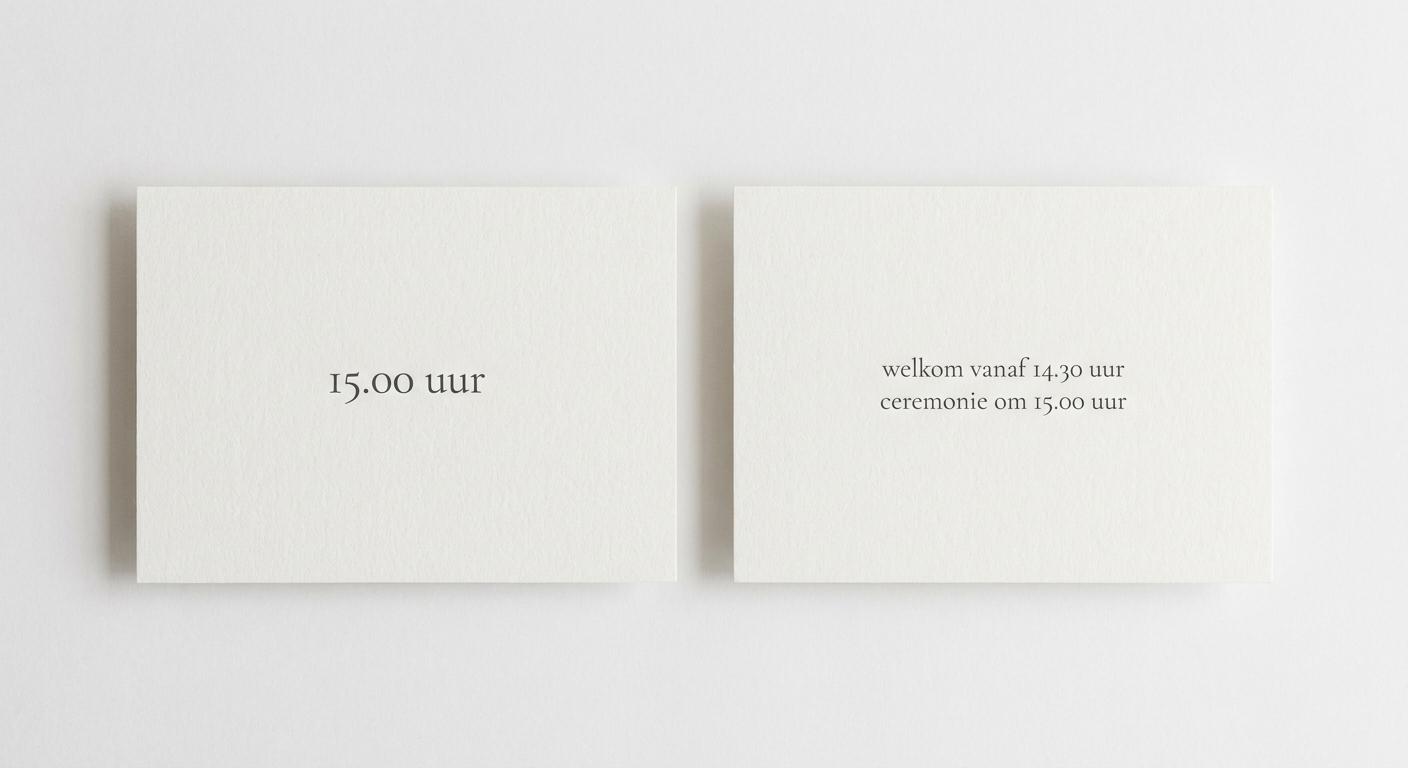
The part of the day is not clear. Someone sees a party venue and a time and assumes they are invited for the whole day. Spell out exactly what you are inviting someone to.
The deadline is missing. Some of your guests then only reply once you call, and you will be making those calls in exactly the weeks when you are busiest anyway.
The tone switches halfway through. The top says "request the pleasure of your company", the bottom says "let us know if you're coming!". Pick one register and stick to it across the whole card, including the RSVP card and the insert.
Then do one more thing before you press order: have the card read by someone who knows nothing about your plans. Ask them where they need to go, what time they need to be there, and what they need to do to reply. If they can answer those three questions without calling you, the wording is done.

Rowin Mol
Rowin Mol is the founder of BruiloftBuddy. He got married in 2024 and, while planning his own wedding, found that on top of the tools he was using he still needed a separate spreadsheet for the guest list, attendance and the wedding day timeline.
Out of that frustration he built BruiloftBuddy: the platform he wished he'd had himself.
Try it yourself
Build your own wedding website
The editor on the homepage is the real editor, not a video. You see what you're making straight away.
Open the editorRowin Mol
Rowin Mol is the founder of BruiloftBuddy. He got married in 2024 and, while planning his own wedding, found that on top of the tools he was using he still needed a separate spreadsheet for the guest list, attendance and the wedding day timeline.
Out of that frustration he built BruiloftBuddy: the platform he wished he'd had himself.
Try it yourself
Build your own wedding website
The editor on the homepage is the real editor, not a video. You see what you're making straight away.
Open the editorLess than you think. An A6 card is 105 by 148 millimetres, and your names, the design and some white space need to fit on it too. Stick to the six basic elements and put the rest on a separate information card or on your wedding website. Not sure? Print the invitation once at actual size and put it on the table. On paper you can see straight away whether it is too full.
That belongs to the formal version and dates from the time when the parents paid for the wedding. These days it is a choice. If you do it, put the names of both sets of parents below or above the couple's names, in a smaller font. If you leave them out, nobody will bat an eyelid any more.
Work backwards. You want the invitations on the doormat well before your RSVP deadline, the printer needs time to deliver, and a proof adds a few more days on top. Ask your printer about the delivery time and add a week for the final round of corrections. You will need that week, because there is almost always one more mistake in the text that nobody spotted.
Nobody will mind a short line used among family and friends. A complete poem by a living poet is protected by copyright, and then it is good form to credit the poet or ask permission. If you want to avoid any hassle, choose a poet who died more than seventy years ago (the copyright has then expired), or write two lines yourself. Something you wrote yourself often works better on a wedding invitation than something borrowed anyway.
Traditionally the bride's name comes first. It is not a rule anywhere, and with two brides or two grooms there is nothing to follow. Say both orders out loud once and pick the one that flows best. Then stick to that order everywhere: on the save the date, the invitation, your wedding website and later the thank-you cards.
One per address. A couple or a family gets one invitation together with all their names on it, so you count the addresses on your guest list. If you print separate versions for day guests and evening guests, count per version. Then order a handful extra. There is often an address you forgot, a card sometimes goes wrong while you are writing it, and you will want to keep one yourself. Reordering means waiting for the printer again, and by then you usually do not have that time.


