Demi Mol · October 8, 2026 · (2 months ago) · 10 min reading time · updated Nov 19
In short
You have been asked to say a few words at the wedding. When you said yes it seemed like a nice idea; now you are sitting in front of a blank page.
Short answer: a good wedding speech lasts three to five minutes and revolves around one or two concrete stories that only you can tell. Collect memories first and only then start putting them into words. Feel free to read it from paper; nobody will bat an eyelid. Finish with a toast, so the room knows when to raise their glasses.
This piece is about a guest's speech: a parent, a witness, a friend or a colleague. If you are the one getting married, you are looking at your vows or your thank-you speech, and that is a different job.
Below is the whole route: what makes a speech land, how long it should be, how to find material and which structure gives you something to hold on to. After that: what to leave out, how to practise, what to do if you get emotional, what differs per speaker and when it is your turn. Is the wedding this weekend? Skip to "How do you start with just a blank page?", where you will find the short route at the bottom.
A good speech tells something that really happened. That is also what people are still retelling a month later: the story that had half the room chuckling, or that one line the couple didn't know you felt that way about.
Weak speeches have one thing in common: they aren't specifically about anything. "Lisa is a warm person, always helpful, always there for everyone." That could be about half the room. A list of qualities doesn't make anyone feel anything, however true those qualities are.
Replace a line like that with the event it comes from. That time Lisa got in the car at half past eleven at night because you had a flat tyre on the A2 motorway. Then you no longer need to say she is helpful; the room has already worked that out.
Online you will find whole collections of ready-made sample speeches, and there is something to learn from them: in a few minutes you can see what a structure looks like and where the toast goes. Copying them rarely works, because the room hears straight away that the words aren't yours. Use them for the form and fill them with your own material (or ask Chat…)
Three to five minutes. That is roughly 400 to 700 words, because you speak more slowly than you read.
Under two minutes, it feels as if you didn't really make the effort. Over seven minutes, the room starts to nod off and glance at the door. A room that has just eaten and already sat through two speakers has a shorter attention span, however good your story is. Four minutes is a safer target than seven.
Are there several speeches in one evening? Then coordinate with each other, or let the master of ceremonies (ceremoniemeester) do it. Four speakers of five minutes each is twenty minutes of talking, and that can easily put an evening programme behind schedule.
Test the length out loud with a timer. The word count is only a rough estimate: you add pauses, and when people laugh you stand there waiting for it to die down.
By not writing yet.
The usual approach is to open a blank document, type "Dear Anne and Tom" and then stare at the cursor for ten minutes. You are trying to do two things at once: work out what you want to say and, at the same time, how to say it.
Separate the two. Two or three weeks before the wedding, start a note on your phone and throw in whatever comes to mind:
Ask around too. Brothers, sisters, colleagues and old housemates know things you don't, and one phone call gets you more than an evening of digging on your own.
After a few weeks you will have a list of twenty lines. Pick the two or three strongest and let the rest go. That cutting is the real work.
Is the wedding only a few days away? Then there is a shorter route. Set a timer for fifteen minutes and write down everything that comes to mind about the two of them, without judging. Then ring one person who also knows them well and note down what they tell you. Pick one story from that list, write half a page around it that evening and read it out loud once the next morning. That works better than waiting three evenings for a better idea.
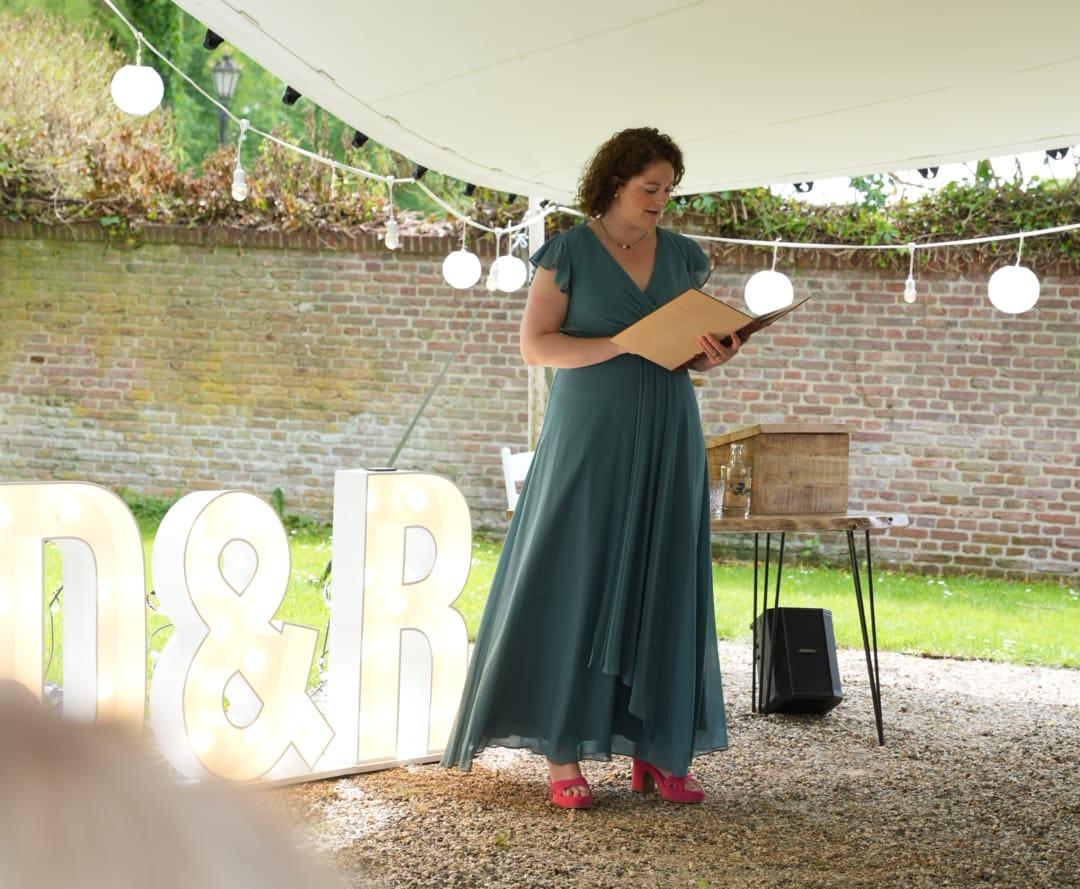
This structure gives you something to hold on to without turning your speech into a fill-in-the-blanks exercise.
Who you are. One or two sentences. Not everyone in the room knows you, and it gives you an easy start. "I'm Sanne, I shared a student house with Anne for four years, so I've seen things." Give the groom a long, meaningful look on those last words, and your first laugh is in the bag.
The story. The heart of your speech and by far the biggest part. One event, told with detail: where you were standing and exactly what they said. Without those details you are left with a summary, and nobody laughs at a summary.
The turn to the couple. This is where you link the story to their relationship. What did you see change when they met? Or, if you have only known them as a couple: what were they like the first time you saw them together?
Something about the other one. If you mainly know one of them, say something about the partner too. Even if it is just one sentence that shows you have noticed them. A speech in which half the couple barely features stands out in an unfortunate way.
The ending and the toast. Keep it short and give the room a clear signal that glasses can go up. Without that signal, everyone sits there waiting awkwardly.
A rehearsed joke as an opener is deliberately missing here. A serious first line is perfectly fine, and a laugh that comes from your own role or your own story lands better than an icebreaker you went looking for.
The classic missteps are easy to predict:
Not sure about a story? Run it past someone close to the couple. One quick message, and it saves you an awkward silence in the room.
Out loud, and more than once the night before.
Reading in your head always goes well. Only when you say it out loud do you hear which sentences are too long and which joke makes no sense spoken. Aim for three or four run-throughs, and have someone listen in on the last one.
A few things that make the difference:
Then you pause for a moment.
The room rarely minds, and the couple certainly don't. It only gets awkward if you carry on while your voice has given up, because then nobody can understand you and you start talking faster just to get through it.
What helps: put your finger on the line where you stopped and take a sip of water. That silence feels longer to you than to the room. If you notice while practising that a particular part gets to you every time, don't put it right at the end, because the tension builds as you speak.
Give a copy of your text to someone next to you, for example the master of ceremonies or a fellow guest. They can take over if you really can't go on. You will probably never use that safety net, and just knowing it is there takes the edge off.
The structure above works for all three. The difference lies in your position and the material that comes with it.
You are the only one in the room who can tell what someone was like before everyone else came along. That is your position, so use it. Pick one childhood memory that says something about who your child is now, and skip the chronology of their entire upbringing.
Also welcome the partner into the family, and mean it. On the other side of the room sits a family of in-laws waiting for exactly that. Keep it to five minutes, even if you have material for twenty.
In the Netherlands, the witnesses who sign at the civil ceremony are usually the couple's closest friends or siblings. Of all the speakers, you are closest to the couple, so you can be the most personal. That also calls for the most self-control, because you know exactly which stories don't belong in a full room. You have also seen them get through things together that the rest of the room knows nothing about. Say something about that, even without filling in the details. Want to know what is expected of you besides the speech? Read what a witness does at a wedding.
As a friend, you have the most freedom in tone and usually the juiciest material. The risk is the in-joke: an anecdote that is hilarious for your little group and impossible to follow for the rest of the room.
Test every story with one question: would the bride's aunt get this too? If not, add two sentences of context or choose something else. Speaking with several friends? Divide the topics beforehand, otherwise you will end up telling almost the same thing twice.
Usually during dinner, between courses, or at the start of the evening programme. Find out two things beforehand: how much time you have, and who speaks before and after you.
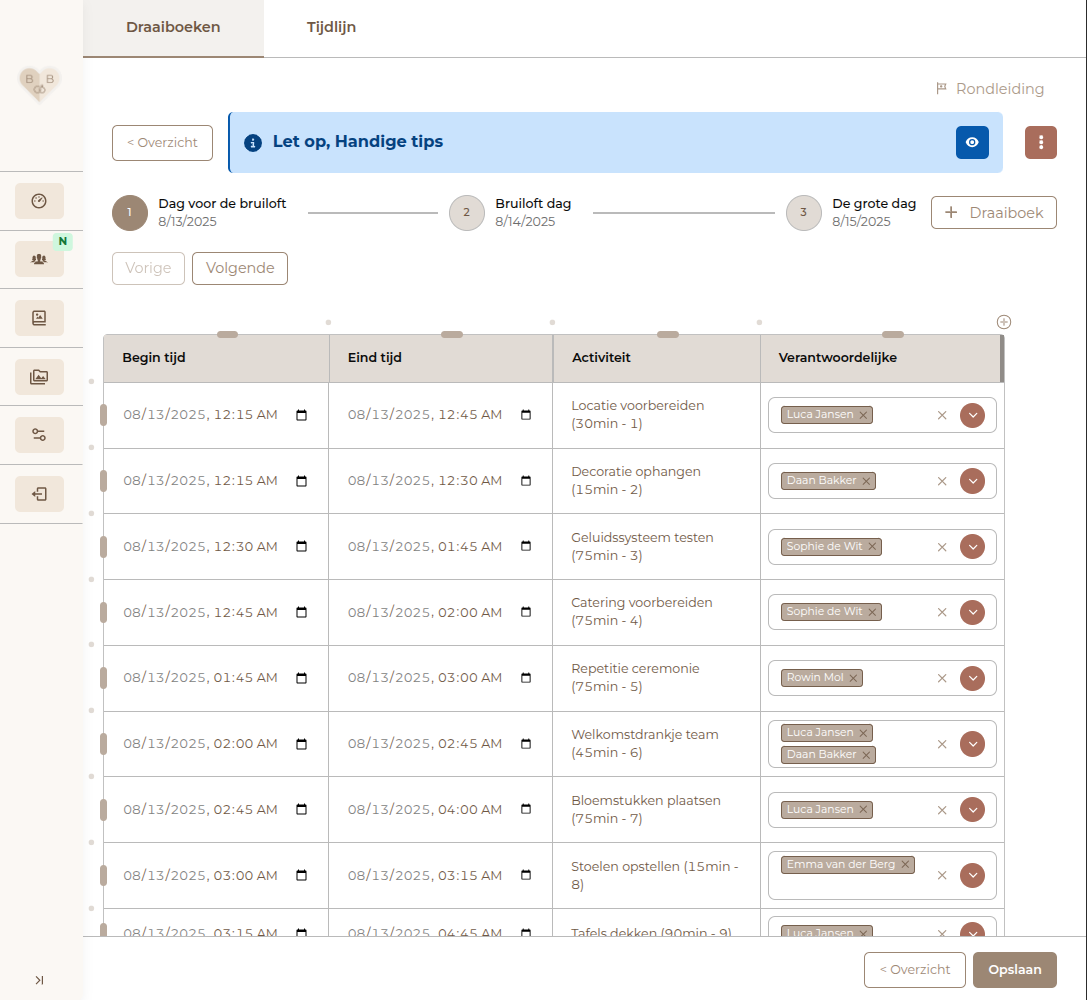
Check with the master of ceremonies rather than waiting to be told. If the speeches overrun by a quarter of an hour, the rest of the evening shifts with them and the band and photographer are left waiting. That is why whoever plans the day puts the speakers, with their names and time slots, in the wedding day timeline, so everyone knows when it is their turn.
For you as a speaker, it mainly takes the pressure off: you can prepare for it. Having a microphone unexpectedly thrust into your hands halfway through your main course is a bad start.

Demi Mol
Demi Mol got married in 2024 and, while planning her own wedding, noticed that the organisation could be a lot smarter and clearer.
Drawing on her background as a project manager, she now uses that experience to build the ultimate structure and planning method for BruiloftBuddy: exactly the overview she was missing herself.
Try it yourself
Build your own wedding website
The editor on the homepage is the real editor, not a video. You see what you're making straight away.
Open the editorDemi Mol
Demi Mol got married in 2024 and, while planning her own wedding, noticed that the organisation could be a lot smarter and clearer.
Drawing on her background as a project manager, she now uses that experience to build the ultimate structure and planning method for BruiloftBuddy: exactly the overview she was missing herself.
Try it yourself
Build your own wedding website
The editor on the homepage is the real editor, not a video. You see what you're making straight away.
Open the editorThree to five minutes, roughly 400 to 700 words. If there are several speakers, keep it on the short side and agree the order with the master of ceremonies (ceremoniemeester).
Yes, and that is what we would do too. Learning it by heart is exactly what goes wrong the moment you get emotional. Print the text in a large font and look up at the end of each paragraph.
Just say so, and then talk about what you have seen: how your friend talks about them, what changed. Keep it to one sincere sentence about the partner and do not make up compliments.
Briefly, yes. Agree which story you will tell and how much time you will take. You do not need to let anyone read your whole speech. That way you avoid repeated anecdotes and a programme that overruns by half an hour.


