Rowin Mol · September 30, 2026 · (2 months ago) · 11 min reading time · updated Nov 19
In short
You have a blank page and the task of summing up, in two minutes, why you want to share the rest of your life with someone.
Short answer: you write vows by collecting first and writing later. For a few weeks, jot down loose memories, quirks and moments when you thought: yes, you. Pick the strongest four or five, add a few promises you can genuinely keep and aim for around two minutes of speaking time. Expect your first draft to be too long and too safe. Cutting is part of the job, and humour can be worked in later.
This is the kind of task that easily gets left until the last week, while time is exactly what makes the difference here. Below is the whole route: what vows are, how to find material, which structure works, how long they should be, what you are better off leaving out, how to read them on the day and when to start all of this.
Is your wedding only two weeks away? Skip to "When do you write them?", where you will find the short route.
In the Netherlands, the official part of your marriage is saying "I do" in front of the registrar. That is the legal commitment, and the wording is fixed.
Vows are the personal part you add around it. Optional and free in form: you decide what goes in them. Some couples say them just before the "I do", others in a separate ceremony somewhere else, for example with only their witnesses present. Agree with your registrar where that moment falls in the ceremony.
Online you will come across different words for the same thing: vows, wedding vows, personal vows, marriage vows. There is no real difference between them; it is all that personal text you read to each other.
Don't underestimate that moment. The "I do" is short and follows a set pattern; in your vows, your own voice is heard. Looking back, I call the vows the most beautiful moment of my own wedding day, even more than the "I do" itself.
The classic mistake is wanting to write straight away. You open a new document, type "Dear", and stare at the cursor for ten minutes.
Turn it around. Spend a few weeks collecting material first, without having to put anything into words. Start a note on your phone and throw in whatever comes to mind:
After two or three weeks, you will have plenty. Pick the strongest four or five and let the rest go. That cutting is the real work, and the reason to start early: choosing from twenty lines gives you something better than stretching out three.
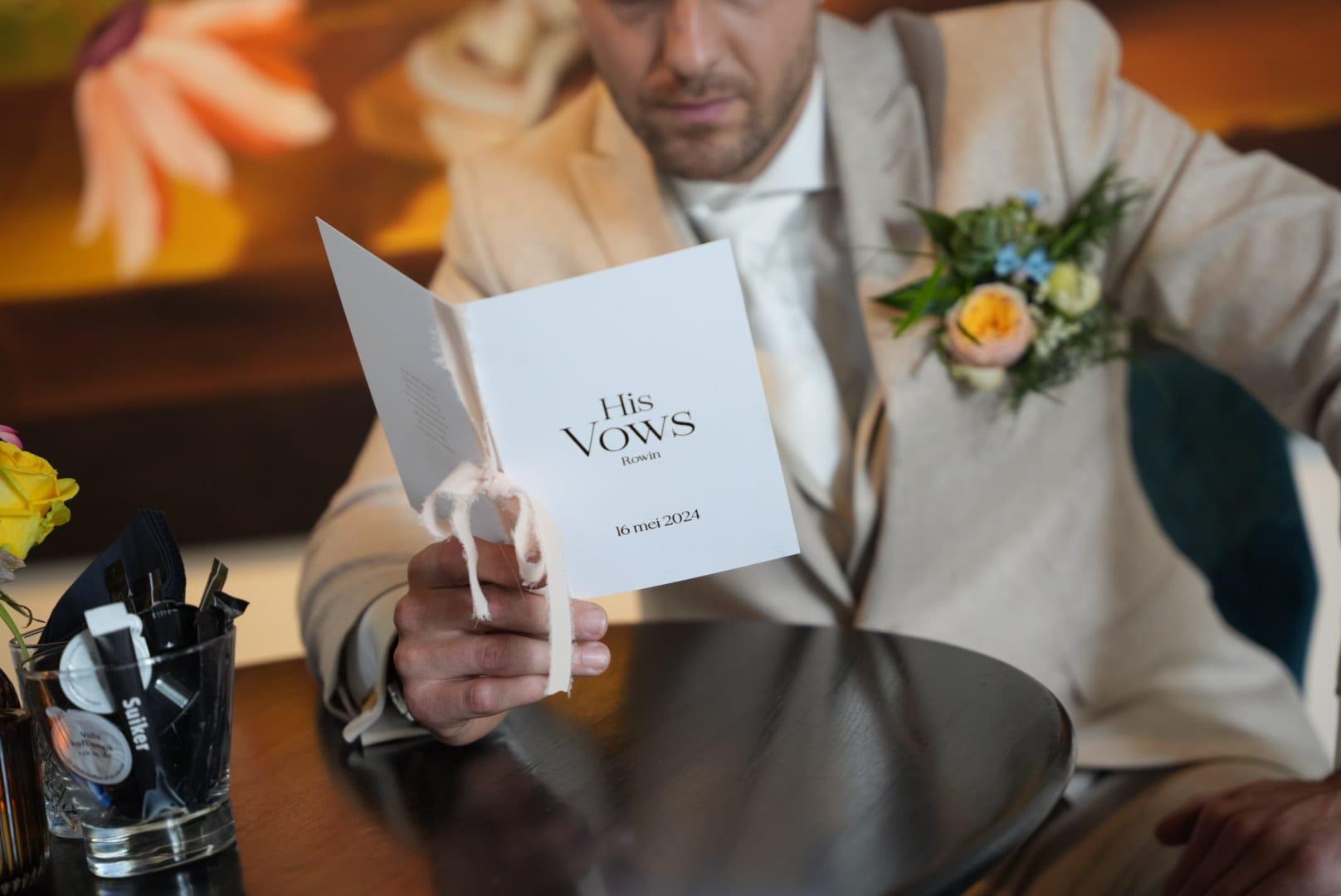
There is no set format, and that is exactly what makes it tricky. The structure below gives you something to hold on to without turning your vows into a fill-in-the-blanks exercise. Five ingredients:
The difference between vows that land and vows that drift past the room lies in being concrete, not in how much of your history you can fit in. Two examples, made up for illustration:
And for a promise:
Your partner is standing a metre away. Anything general enough to fit on a greetings card can go.
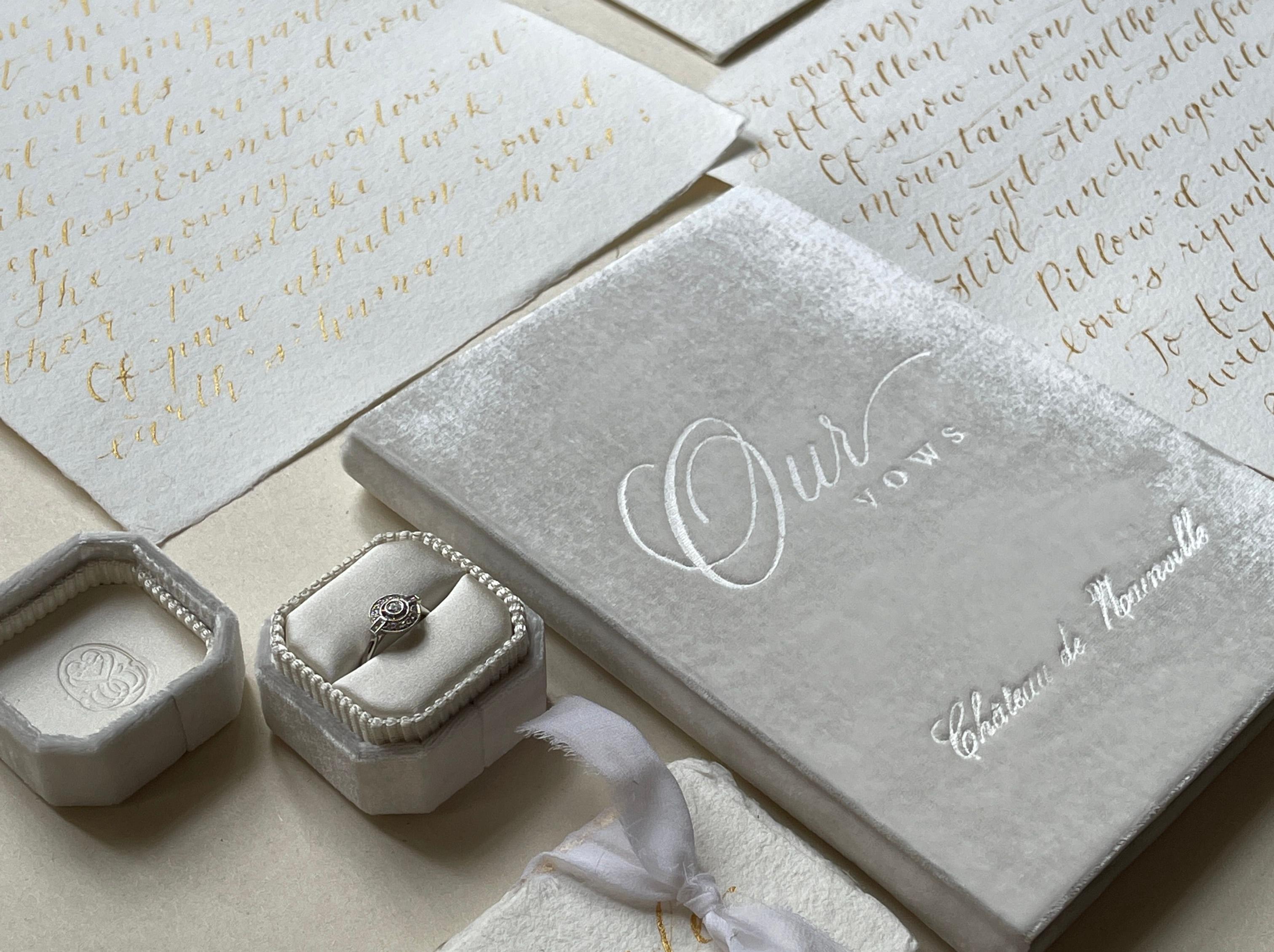
Our recommendation: about two minutes of speaking time, so roughly 250 to 300 words. That is the guideline we use ourselves; there is no official standard. On paper it looks like very little. Out loud, it turns out to be more than you think, because you speak more slowly than usual and emotion slows you down further.
If it gets longer, you run two risks. The room loses interest, and you find yourself halfway through with a shaky voice and half a page still to go. Want to say more? Write a letter and have it delivered in the morning, so not everything has to fit into those two minutes.
Test it out loud with a timer before you are happy with it. Reading along in your head goes much faster than reading aloud with a microphone in your hand.
What we would leave out:
This conversation is easily forgotten, and it saves a lot of awkwardness on the day itself. Four things to agree on together.
The tone. If one of you reads a light-hearted piece with three jokes and the other an emotional letter, it feels uncomfortable. Agree roughly where you will both pitch it. Jokes are fine, as long as you both know that's the direction.
The length. Agree on a target time, otherwise one of you speaks for forty seconds next to someone who speaks for five minutes.
Whether to read them to each other beforehand. Both work. Swapping them in advance takes the pressure off and avoids you both using the same anecdote. Keeping them secret makes for a stronger moment on the day. Choose one deliberately, so one of you isn't quietly hoping for a surprise while the other has already sent everything over.
Who goes first. A small detail, but a lot of shuffling if you leave it open. Put it in the timings for the day, together with the rest of the ceremony, so your wedding day timeline is right and your master of ceremonies (ceremoniemeester, the friend who runs the day) knows what is coming.
Do the two texts need to be similar? In content they can be miles apart; nobody will mind. It does help if tone and length are in the same ballpark.
Read them out!
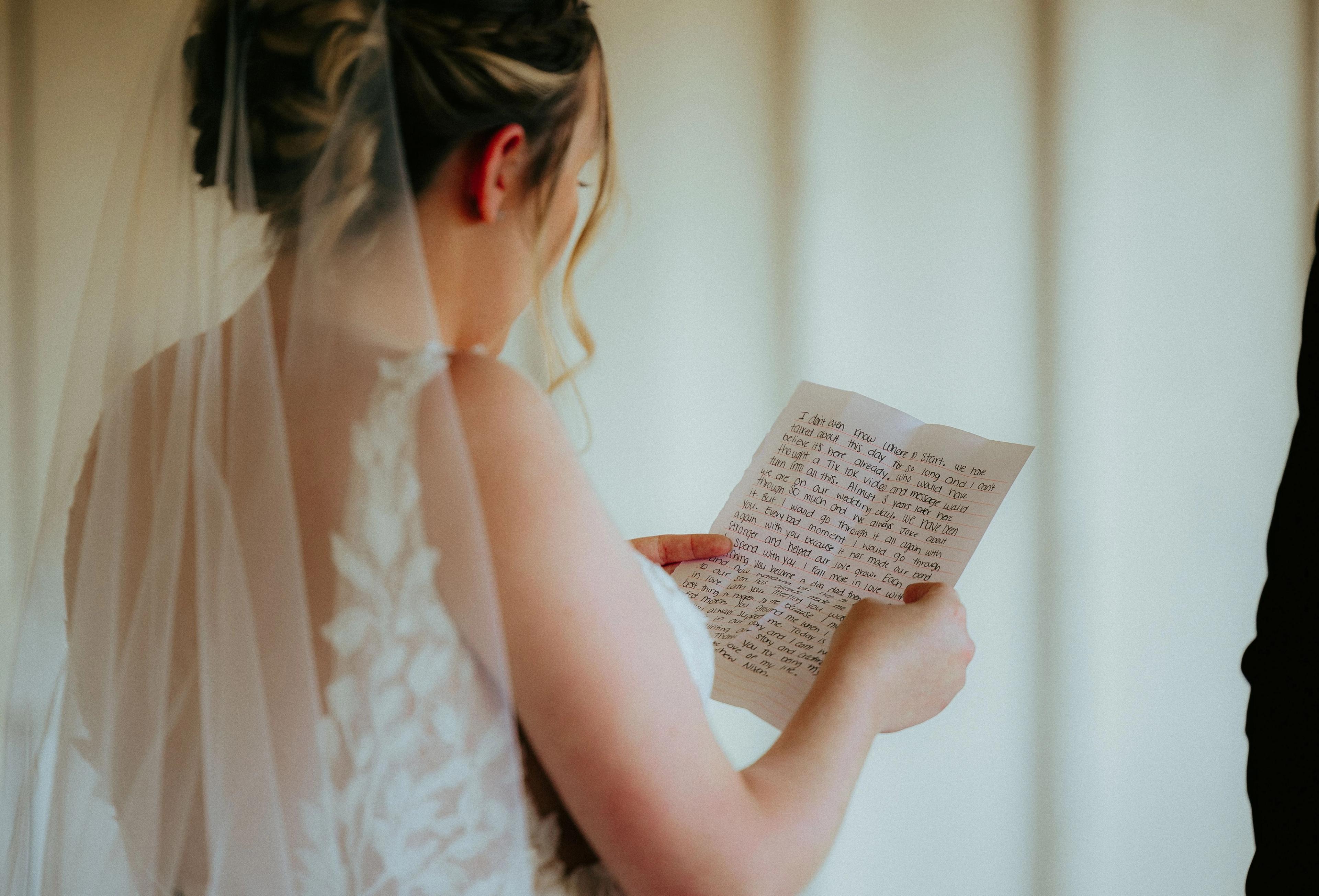
Learning them by heart sounds lovelier, until you get emotional. And that happens right there, with a room full of people watching while you search for the next word. Everyone sees the card in your hand and nobody holds it against you; they know perfectly well you wrote it down.
Now the practical part, because this is what goes wrong on the day itself:
Start collecting as soon as the date is set. The writing comes later, but material trickles in slowly and in the last week you don't want to rely on your memory.
A workable order:
The night before my own wedding, I was already sleeping at the hotel where we were getting married, and that evening was spent on the weather forecast: we wanted to get married outdoors and have a relaxed dinner. On an evening like that, you are busy with all sorts of things, except searching for the right words. (The weather held, and we got married outside.)
Is your wedding only two weeks away? Then it can be done faster. Set a timer for twenty minutes and write down everything that comes to mind, without judging. The next day, underline the four lines that stand out, spend one evening building on them and read it out loud once to a wall. That gets you further than three weeks of putting it off because it has to be perfect.
Five things that help when nothing comes:
One last thing: ask someone to record the moment, even if it's on a phone from the second row. Of those two minutes you worked on for weeks, often less stays in your head than you would like. And keep the cards; they weigh nothing, especially if they are one of those sets made for exactly that.

Rowin Mol
Rowin Mol is the founder of BruiloftBuddy. He got married in 2024 and, while planning his own wedding, found that on top of the tools he was using he still needed a separate spreadsheet for the guest list, attendance and the wedding day timeline.
Out of that frustration he built BruiloftBuddy: the platform he wished he'd had himself.
Try it yourself
Build your own wedding website
The editor on the homepage is the real editor, not a video. You see what you're making straight away.
Open the editorRowin Mol
Rowin Mol is the founder of BruiloftBuddy. He got married in 2024 and, while planning his own wedding, found that on top of the tools he was using he still needed a separate spreadsheet for the guest list, attendance and the wedding day timeline.
Out of that frustration he built BruiloftBuddy: the platform he wished he'd had himself.
Try it yourself
Build your own wedding website
The editor on the homepage is the real editor, not a video. You see what you're making straight away.
Open the editorNo. The official part is saying "I do" in front of the registrar. Vows are an optional extra, and some couples skip them, for example because speaking in front of a group is too nerve-racking.
None. Vows, wedding vows and wedding promises are all words for the same personal text you say to each other at your wedding. In Dutch they are called geloftes or a trouwgelofte.
Yes, and that is what we would do too. Learning them by heart tends to go wrong the moment you get emotional. Print them on sturdy paper, in a font size you can read easily from half a metre away.
It happens, and your guests will not mind. Breathe, pause for a moment and carry on reading; that silence feels much shorter to everyone else than it does to you. Give a copy to your witness, so they can take over if you really cannot go on.


