Demi Mol · October 2, 2026 · (2 months ago) · 11 min reading time · updated Nov 19
In short
Two days before our wedding we were sitting at the kitchen table folding popcorn favours and making little cards. Doing it ourselves was a conscious choice: we enjoyed it and it suited our budget better. A bit late, though...
Short answer: a favour is a small gift that guests take home as a thank you for coming. It isn't compulsory. Count one per guest for something edible and one per household for something for the home, order a few more than you think you need, and plan the wrapping three to four weeks beforehand.
The rest of this article covers what you only run into once you're in the middle of it: how many you really need to order, and whether evening guests get one too. And who will set them out on the day. Only a few weeks to go? Skip the timeline and start at "How many favours should you order?".
A favour (in Dutch a bedankje) is the small gift guests take home from your wedding. Usually something edible, with a little card showing your names as a couple and the date.
The idea behind it is simple: people have put time and money into your day, often a day off work too, and this is the gesture back. Don't expect too much of it beyond that. It carries about as much weight as a chocolate, and that is how your guests see it too.
When couples talk about wedding thank-yous, two things often get mixed up. The first is the small gift on the day itself, and that is what this article is about. The second is the thank-you card you send after the wedding, usually with a photo on it, for coming and for the gift. One doesn't replace the other, so you can do both.
That card has its own timing, because you need your wedding photos for it. So ask your photographer before the wedding how long it will take to get the photos. If they deliver within a few weeks, the cards can go out a month after the day. If it takes three months, everything shifts with it. Put the stamps in your budget now: with a hundred addresses, it adds up.
No. Plenty of weddings go without favours. If your budget is tight, you can drop this budget item without your day being any the worse for it.
What guests do notice is something put out for show when nobody knows whether they're allowed to take it. If you do give favours, give them a card and a clear spot. Otherwise a line in your speech works just as well.
For us this came last, and that's not the handiest order. Favours feel like a detail until you have to wrap a hundred of them.
There are four decisions involved, and each builds on the last: whether you give them, what they will be, how many you need, and who sets them out on the day. The second determines the third, because you count edible favours per person and things for the home per household. And the fourth is something you can't fix later.
A timeline that works:
Only a few weeks to go? Then half of this falls away and this is what's left. Choose something without personalisation that is in stock, order it this week, and agree straight away who wraps it and who sets it out on the day. A ready-made favour with a handwritten card attached works perfectly well. A personalised order that arrives two days too late is no use to anyone.
Edible favours get wrapped later, because you're tied to the shelf life. Fresh things such as homemade biscuits are best made in the last few days, preferably not the evening before you leave.
Pure arithmetic, and you only notice a wrong number on the day itself.
Per person or per household? Give edible favours per person, because nobody shares a chocolate with their partner. Give something for the home, such as a small plant or a candle, per couple or per household. So count your households first: if your guest list is mostly couples, that number will be much lower than your number of guests.
Do evening guests count? Decide this in advance, or you'll get the question on the day itself. Two workable approaches: everyone gets the same, or the day guests find the favour on the table and there is something smaller for the evening guests by the bar. It becomes awkward when one half of the room takes something home and the other doesn't, with no visible logic. You can read more about what to arrange for evening guests in evening guests at your wedding.
For that you need to know your numbers per part of the day. If you keep your guest list per part of the day, that number comes out straight away. If you work with separate lists, count again by hand: the difference between "120 guests" and "120 day guests plus 40 evening guests" is a third of your order.
Allow a margin. We would take five to ten per cent extra. Something breaks, and someone turns up with a plus-one out of the blue. If every favour has a name on it, that margin doesn't work and your number has to be exactly right.
Don't forget the people behind the scenes. Your masters of ceremonies (ceremoniemeesters, the friends who run the day), your witnesses and the people who helped set up are rarely on the list as "guests", yet you do want to give them something.
Children separately. A bottle of wine or an espresso cup does nothing for a six-year-old. A bag of sweets or something to play with during dinner does, and it buys you half an hour of peace at the table too.
Prices vary widely and change by season, so naming fixed amounts makes little sense. Think in three levels.
At the bottom are small edible treats, seed packets and anything you wrap yourself. Above that comes personalised work: a chocolate bar with your own wrapper, a jar of jam with your own label. You usually pay separately for that personalisation, on top of the product. At the top are engraved and handmade items, miniature bottles of drink and ceramics. Lovely, and with a long guest list rarely worth the money.
That choice weighs more heavily than it feels in the web shop, because of the multiplication. With 120 guests, every euro per favour costs you a hundred and twenty euros. A two-euro difference per item barely shows on a product page, yet at that number it becomes a serious line in your budget. So always work it out as a total and set it against the rest of your wedding budget.
Also watch out for the costs that aren't in the unit price:
More ways to keep budget items like these in check are in our article on keeping costs under control.
The rule of thumb we follow: give something your guests eat, use up or use that same day. Anything meant to sit on a shelf usually never makes it to the shelf.
The safest category, because it gets eaten.
Two things to watch out for. Chocolate melts at an outdoor wedding in summer, so don't leave it in the sun for hours. And nuts, gluten and lactose end up in a favour more easily than you'd expect: if you know which dietary requirements and allergies are on your guest list, take them into account or put the ingredients on the card.
Choose something here that fits in a coat pocket. Anything bigger than a hand becomes a problem for guests who come by bike or by train, as many do in the Netherlands.
This category does double duty: it's a favour and it solves a practical problem at the same time.
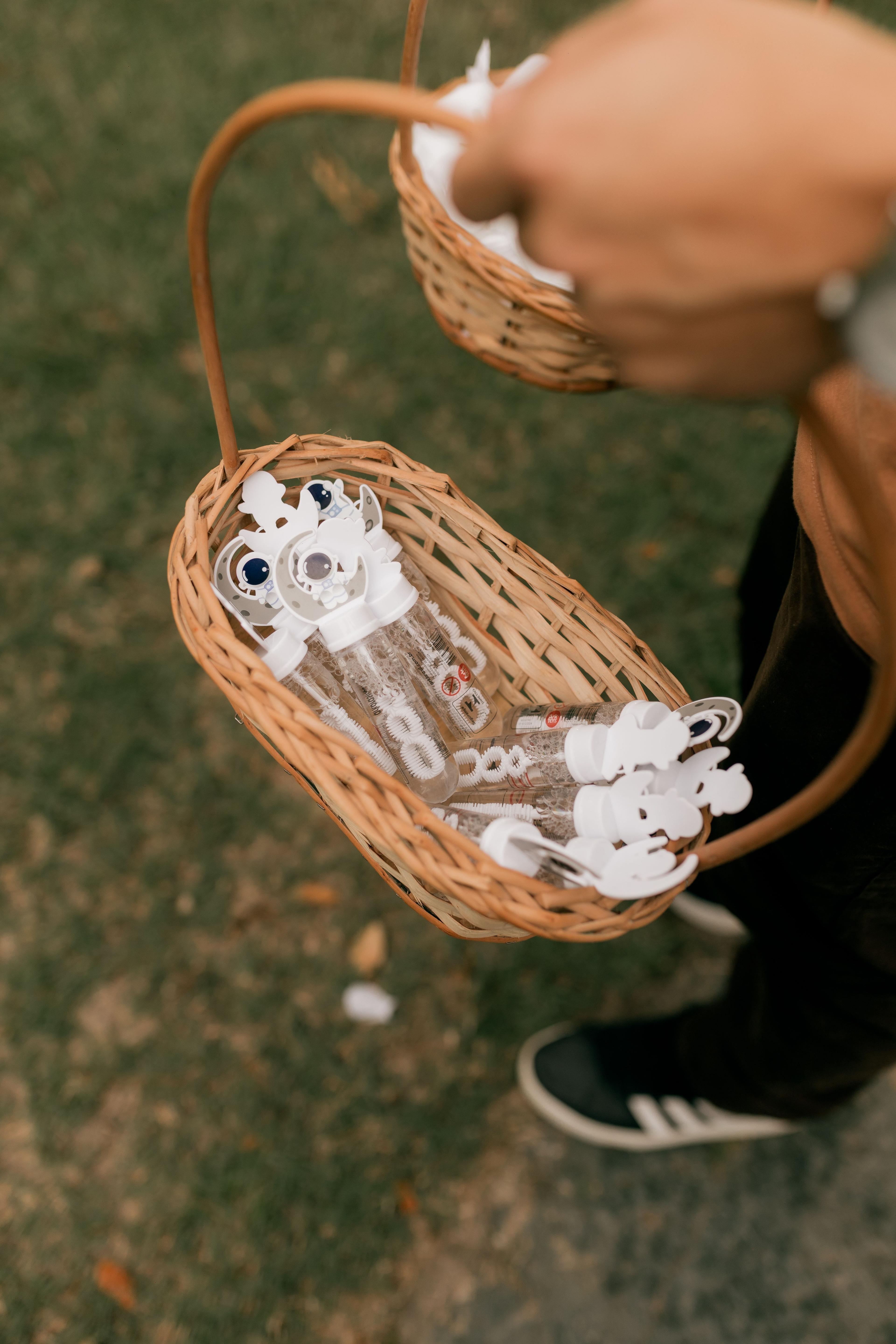
A donation to a charity that means something to you, with a card on the table saying what you did and why. This only works if the reason is genuinely yours. If you do it because it looks good, that shows straight away.
Making them yourself costs less money and much more time than you expect.
Test it before you decide. Wrap five favours completely, from product to ribbon to card, and time how long it takes. Multiply that by your number and add a quarter of an hour for starting over. If it comes to more than one evening, plan two and keep the last week free.
It's more fun than it sounds, as long as you start in time and have someone sitting next to you. We did it together, two days beforehand, and it was cosy enough. Three weeks earlier would have been smarter. Put it in your planning as a task, three or four weeks before the wedding, instead of hoping there will be an evening left.
One thing you should always outsource: anything that involves printing. Your own wrappers, labels and cards from your home printer give themselves away as soon as the rest of your stationery has been professionally printed.
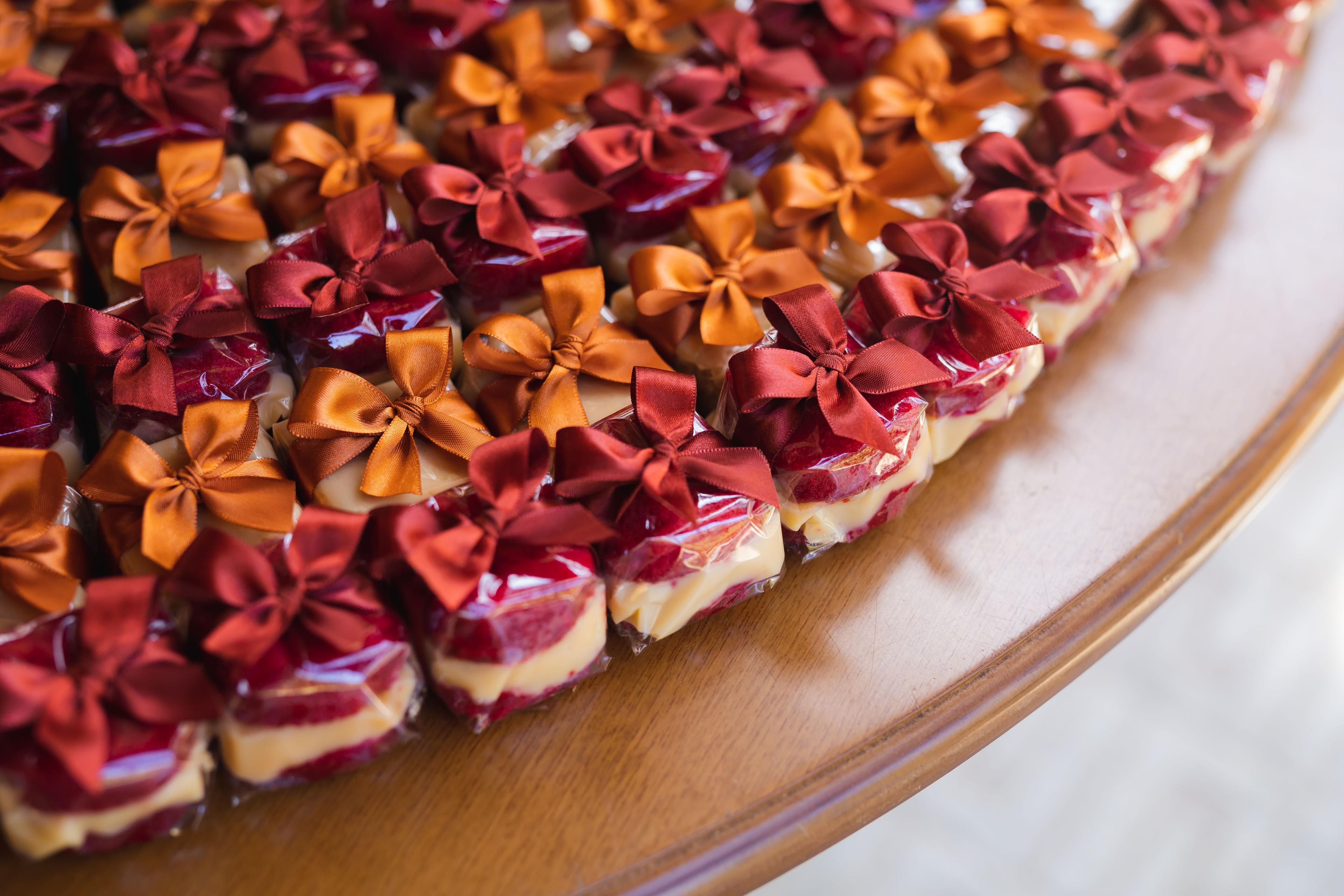
The favour is finished, and there is still one way for it to go wrong: it stays in the box.
On the plate at dinner. The clearest spot: everyone sees it and it belongs to their own seat. Combine it with the place card, and your seating plan is taken care of at the same time. How to make those cards with all the names in one go is explained in DIY place cards for your wedding.
In a basket by the exit or the cloakroom. Only works with a clear sign next to it, otherwise nobody dares to take one. Expect some to be left over.
Handed out by someone. The most personal option and the most work. Only do it if someone really takes it on.
At an outdoor ceremony, only put out fans or tissues just before guests arrive, or they'll blow away or sit in the sun for an hour.
In all three cases, record it in your wedding day timeline, names included: who brings the boxes, who unpacks them, when they are set out, and who collects whatever is left at the end of the evening. You won't be carrying boxes around at your own wedding, and without a name next to it, nobody picks it up.

Demi Mol
Demi Mol got married in 2024 and, while planning her own wedding, noticed that the organisation could be a lot smarter and clearer.
Drawing on her background as a project manager, she now uses that experience to build the ultimate structure and planning method for BruiloftBuddy: exactly the overview she was missing herself.
Try it yourself
Build your own wedding website
The editor on the homepage is the real editor, not a video. You see what you're making straight away.
Open the editorDemi Mol
Demi Mol got married in 2024 and, while planning her own wedding, noticed that the organisation could be a lot smarter and clearer.
Drawing on her background as a project manager, she now uses that experience to build the ultimate structure and planning method for BruiloftBuddy: exactly the overview she was missing herself.
Try it yourself
Build your own wedding website
The editor on the homepage is the real editor, not a video. You see what you're making straight away.
Open the editorNo, nobody expects them of you. If your budget is tight, drop this budget item and your day will be none the worse for it. A few words of thanks in your speech often mean more anyway.
That depends on what it is. Something edible you give per person, because people do not share it. Something for the home, like a small plant or a candle, you give per household. If you go for one per household, put that on the label, otherwise everyone will take one.
That is up to you, as long as you pick one approach and stick to it. Give everyone the same, or put the favours on the tables for the day guests and something smaller by the bar for the evening guests. Do count your numbers per part of the day, though, or you will order too few.
Two to three months before the wedding, and earlier if printing or personalisation is involved. Plan the wrapping three to four weeks in advance. We did not stick to that ourselves and were still folding two days before our wedding.


